Contact Us : +91 90331 80795

Blog Details

Breadcrub
MVP or Full Product: Choosing the Faster Path to Market

MVP or Full Product: Choosing the Faster Path to Market

In today’s fast-moving digital world, speed matters more than ever. New ideas come to market every day. Customers have many choices. Competitors move quickly. In this environment, launching your product at the right time can decide whether your business succeeds or struggles.
 
One of the most important early decisions every startup or growing business must make is:
 
Should we launch a Minimum Viable Product (MVP), or should we build a full product from the start?
 
This decision affects:
 
  • How fast do you go to market

  • How much money do you spend

  • How much risk do you take
  • How easily can you change direction later
At Sparkle Web, we work closely with startups and established businesses to help them choose the right path. We focus on speed, quality, cost control, scalability, and long-term return—not just quick development.
 
This guide explains:
 
  • What an MVP really is

  • What a full product means

  • How do both compare in real life
  • When to choose each approach
  • How to avoid common mistakes


What is an MVP (Minimum Viable Product)?

 
An MVP, or Minimum Viable Product, is a simple version of your product that includes only the most important features needed to solve one main problem for users.
 
The goal of an MVP is not perfection.
The goal is learning.
 
An MVP helps you:
 
  • Test your idea in the real market

  • Understand how users behave

  • Get feedback quickly
  • Reduce risk before investing heavily
 

Key Characteristics of an MVP

 
An MVP usually:
 
  • Focuses only on core features

  • Solves one main user problem

  • Is built quickly
  • Costs less than a full product
  • Allows fast changes based on feedback

It is a starting point, not the final version.


Simple Example of an MVP

 
Imagine a food delivery startup.
 
Instead of building everything at once, the MVP might include:
 
  • User registration and login

  • A list of restaurants

  • Basic order placement
It does not include:
 
  • Loyalty rewards

  • AI-based food suggestions

  • Advanced tracking
  • Detailed analytics
These features can be added later - after proving users actually want the service.


What is a Full Product?

 
A full product is a complete, polished solution that is ready for a larger audience or enterprise use.
 
It is built with:
 
  • Many features

  • Strong design

  • High security
  • Scalability from day one
A full product is often designed for businesses that already know their market and users very well.


Key Characteristics of a Full Product

 
A full product usually includes:
 
  • Many advanced features

  • Polished UI and smooth experience

  • Strong performance and security
  • Support for growth and scale
  • Integrations with other systems

Because of this, it:
 
  • Takes more time to build

  • Costs more money

  • Requires detailed planning
 

Example of a Full Product

 
An enterprise CRM system launched as a full product may include:
 
  • Automation workflows

  • Advanced reports and dashboards

  • Multiple user roles
  • Third-party integrations
  • Security and compliance features

This type of product is expected to work at scale from the first day.


MVP vs Full Product: Timeline and Effort Comparison
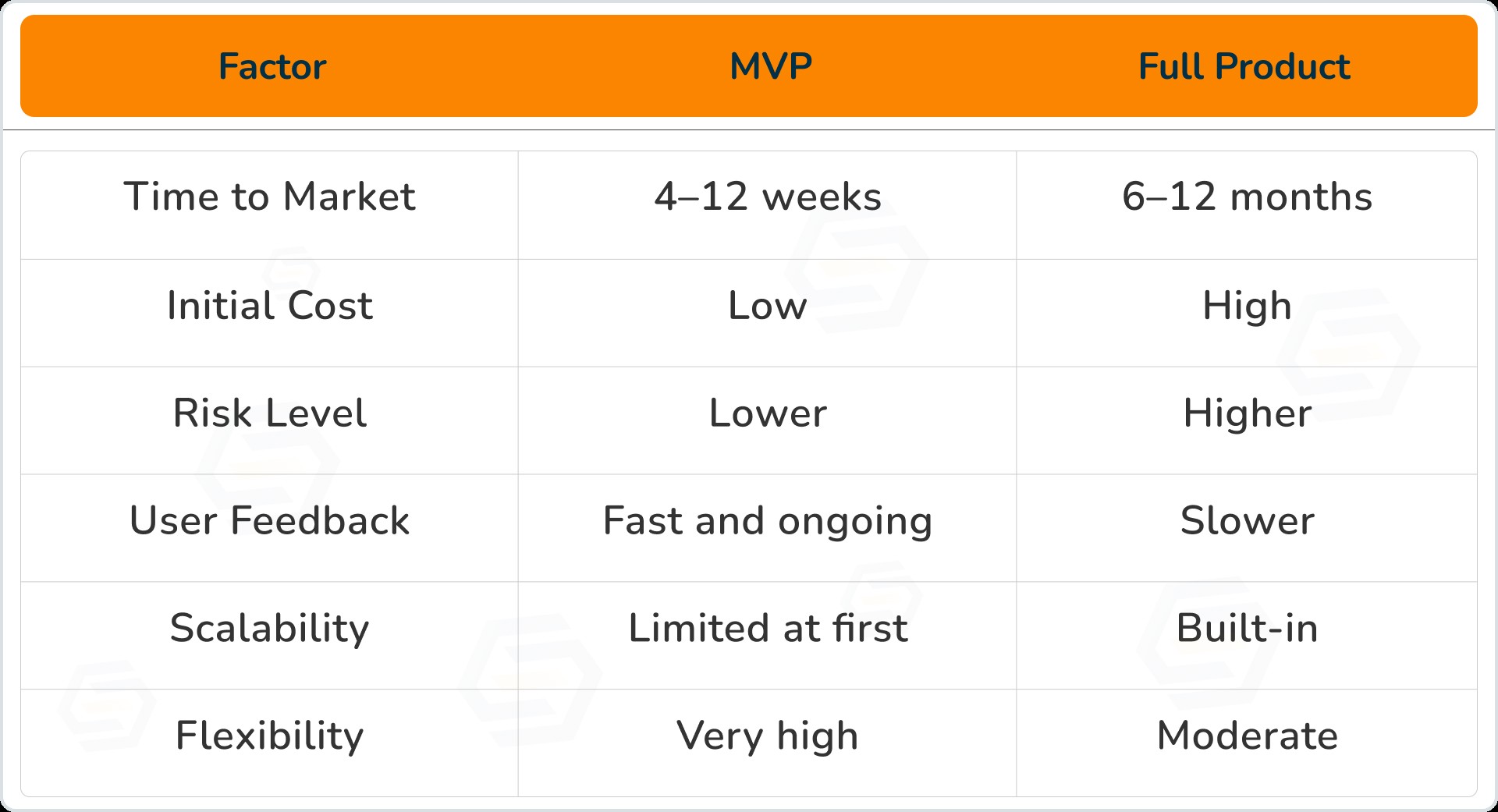
 
Let’s look at how both approaches compare in real terms.
 
 
If your main goal is speed and learning, an MVP is usually the better choice.


When Should You Choose an MVP?

 
An MVP is a smart option when:
 
  • You are testing a new idea

  • You are unsure about market demand

  • You want feedback from real users
  • You need something to show investors
  • Your budget or time is limited


Why MVPs Reduce Risk

 
Many startups fail not because of bad technology, but because they build something nobody really wants.
 
According to research, 42% of startups fail because there is no real market need.
 
An MVP helps you:
 
  • Validate demand early

  • Avoid wasting time and money

  • Build features users actually ask for
 

When Does a Full Product Make More Sense?

 
A full product may be the right choice when:
 
  • Your idea is already validated

  • You are targeting enterprise customers

  • Security and compliance are required
  • You are replacing an existing system
  • Brand image matters from day one

In these cases, a simple MVP may not meet expectations.


MVP and Full Product Together Create Long-Term Value

 
An MVP is not a shortcut or a low-quality product.
It is a smart first step.
 
The fastest path to success is rarely building everything at once.
It is about building the right things in the right order.
 
An MVP helps you:
 
  • Enter the market faster

  • Save money

  • Reduce risk
  • Learn what users want
With the right partner, moving from MVP to full product becomes smooth and planned.


What Should You Build First?

 
When businesses start planning a new digital product, most conversations quickly turn into a debate:
 
Should we build an MVP or a full product first?
 
But the truth is, this is not the real question.
 
The real and more important question is:
 
What problem are you trying to solve first?
 
Before writing a single line of code, successful teams focus on clarity, not features. They understand the problem deeply, know who they are building for, and decide the right starting point based on real business needs, not assumptions.
 
We have seen many projects succeed and fail based on this early decision. The ones that succeed always start with the right questions.


Why the “What to Build First” Question Matters

 
Technology is only a tool.
If you build the wrong thing - even perfectly - you still fail.
 
Many teams rush into development because:
 
  • They want to move fast

  • They are excited about the features

  • Competitors are launching products
But speed without direction leads to waste.
 
That’s why deciding what to build first is far more important than deciding how much to build.


Ask Yourself These Key Questions

 
Before you choose between an MVP and a full product, pause and honestly answer the following questions.
 

1. Do I fully understand my users’ pain points?

 
  • What problem are users facing today?

  • How are they solving it right now?

  • What frustrates them the most?
If you can’t clearly explain your users’ problem in one or two sentences, you are not ready to build a large product yet.


2. Is this idea already validated in the market?

 
Ask yourself:
 
  • Are users already asking for this solution?

  • Do competitors exist?

  • Have customers paid for something similar?
If the answer is unclear, starting small is safer.


3. Do I need investor traction quickly?

 
Investors usually don’t invest in ideas—they invest in proof.
 
An MVP helps you show:
 
  • Real users

  • Early traction

  • Market interest
If fundraising is a near-term goal, speed and validation matter more than feature depth.


4. Am I targeting startups, SMBs, or enterprises?

 
Different audiences have different expectations:
 
  • Startups & SMBs value speed and flexibility

  • Enterprises expect stability, security, and completeness

Your target audience strongly influences what you should build first.


5. What happens if I delay launch by 6 months?

 
Think carefully:
 
  • Will the market move ahead?

  • Will competitors gain an advantage?

  • Will you lose momentum?
If delaying launch hurts your opportunity, an MVP is often the better choice.


Build an MVP First If…

 
An MVP is usually the right starting point when:
 
  • You are launching a new idea or startup

  • Market demand is still unclear

  • You want quick feedback from real users
  • Budget and timelines are limited
  • You need proof for investors or stakeholders


The Goal of an MVP

 
The goal is not perfection.
 
The goal is to:
 
  • Test assumptions

  • Reduce risk

  • Learn fast
  • Build only what users actually need
An MVP helps you avoid spending months building features that users may never use.


Build a Full Product First If…

 
A full product makes sense when:
 
  • Your idea is already proven

  • You are replacing an existing system

  • You serve enterprises or regulated industries
  • Security, performance, and compliance are required
  • Brand image matters from the first launch


The Goal of a Full Product

 
The goal is to:
 
  • Deliver a complete solution

  • Support scale from day one

  • Meet strict business and technical requirements
  • Build trust immediately
In these cases, a simple MVP may not meet expectations or business needs.


The Smartest Path: MVP → Scale to Full Product

 
At Sparkle Web, most successful projects follow a balanced and proven path:
 
1. Build a focused MVP
 
2. Launch quickly
 
3. Collect real user data
 
4. Understand behavior and feedback
 
5. Improve features based on insights
 
6. Scale into a full product step by step
 
This approach allows businesses to move fast without guessing.


Why This Approach Works So Well

 
This flow ensures:
 
  • Faster time to market

  • Lower development risk

  • Better use of the budget
  • Stronger product-market fit
  • Higher long-term return

Instead of guessing what users want, you let real usage guide growth.


Our Recommendation

 
If you are unsure where to start, the safest option is:
 
Start small, but think big.
 
An MVP built with:
 
  • Clean architecture

  • Scalable foundations

  • Quality code
can easily grow into a full product without rebuilding everything from scratch.
 
That’s exactly how Sparkle Web helps businesses grow - step by step, with confidence.


Conclusion

 
So, should you build an MVP or a full product?
 
The answer depends on:
 
  • Your goals

  • Your market

  • Your budget
  • Your timeline
If speed, learning, and flexibility matter most, start with an MVP.
If scale, compliance, and enterprise needs come first, build a full product.
 
At Sparkle Web, we help you choose wisely and build faster - without losing quality or future growth. Contact us and let’s build the right product, the right way.

    Author

    • Owner

      Dipak Pakhale

      A skilled .Net Full Stack Developer with 8+ years of experience. Proficient in Asp.Net, MVC, .Net Core, Blazor, C#, SQL, Angular, Reactjs, and NodeJs. Dedicated to simplifying complex projects with expertise and innovation.

    Contact Us

    Free Consultation - Discover IT Solutions For Your Business

    Unlock the full potential of your business with our free consultation. Our expert team will assess your IT needs, recommend tailored solutions, and chart a path to success. Book your consultation now and take the first step towards empowering your business with cutting-edge technology.

    • Confirmation of appointment details
    • Research and preparation by the IT services company
    • Needs assessment for tailored solutions
    • Presentation of proposed solutions
    • Project execution and ongoing support
    • Follow-up to evaluate effectiveness and satisfaction

    • Email: info@sparkleweb.in
    • Phone Number:+91 90331 80795
    • Address: 303 Capital Square, Near Parvat Patiya, Godadara Naher Rd, Surat, Gujarat 395010