

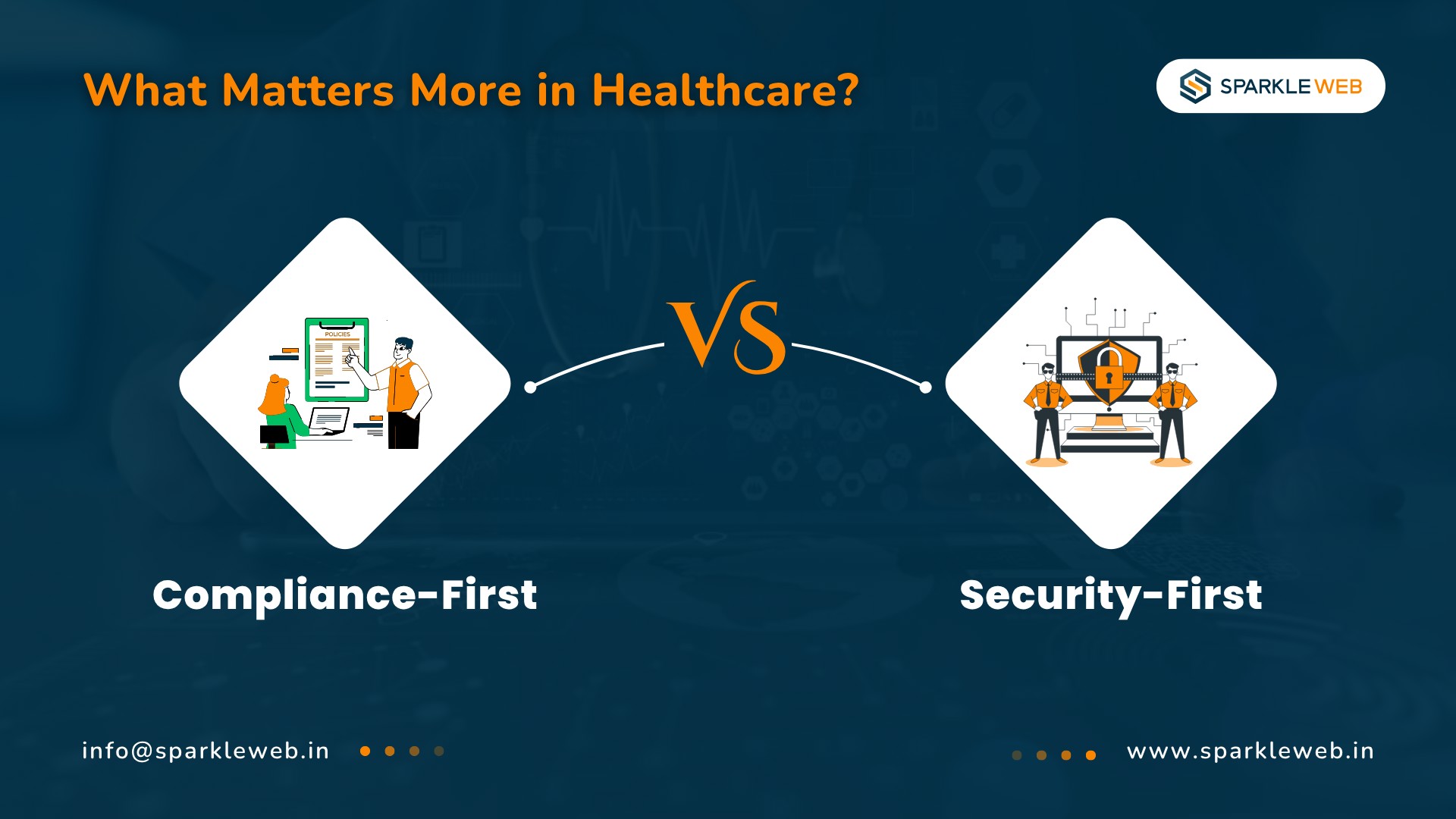
Healthcare is one of the most sensitive industries in the world. It deals with patient records, medical history, personal identity, and life-critical information. This data is not just important, it is deeply personal and must be protected at all costs.
Today, healthcare systems are becoming more digital. Hospitals, clinics, and health-tech platforms are using software for patient records, online consultations, billing, and more. This digital shift has made healthcare faster and more efficient, but it has also increased risks.
Now healthcare organizations face an important question:
Should they focus more on compliance or security?
At first, both may look the same. Both are about protecting data and systems. But in reality, they are different approaches.
Choosing only one and ignoring the other can create serious problems.
To build safe and reliable healthcare systems, it is important to understand both approaches clearly.
What is a Compliance-First Approach?
A compliance-first approach focuses on following rules and regulations set by authorities.
In healthcare, there are strict laws designed to protect patient data. Some well-known examples include:
-
HIPAA
-
GDPR
These regulations define how data should be:
-
Collected
-
Stored
- Shared
- Protected
Organizations that follow a compliance-first approach aim to:
-
Pass audits
-
Avoid legal penalties
- Maintain proper documentation
- Stay within legal boundaries
Advantage of Compliance-First
Compliance provides a clear structure.
It gives organizations a set of rules to follow. This helps ensure that basic data protection practices are in place.
For example:
-
Encrypting patient data
-
Controlling user access
- Maintaining records of data usage
This structure is useful, especially for organizations that are starting their digital journey.
Limitation of Compliance-First
The biggest problem with compliance is that it often becomes a checklist activity.
Organizations may focus only on passing audits instead of actually securing their systems.
This creates a false sense of safety.
A system can:
-
Follow all rules
-
Pass audits
- Still vulnerable to attacks
Regulations are often updated slowly, while cyber threats evolve quickly.
So, compliance alone is not enough to protect modern healthcare systems.
What is a Security-First Approach?
A security-first approach focuses on actively protecting systems from threats.
Instead of just following rules, it focuses on real protection.
This approach includes:
-
Monitoring systems in real time
-
Using strong encryption methods
- Designing a secure system architecture
- Regular testing for vulnerabilities
The goal is simple: to prevent attacks before they happen.
Advantage of Security-First
Security-first organizations are proactive.
They do not wait for problems to happen. They prepare for both known and unknown risks.
They focus on:
-
Preventing data breaches
-
Protecting patient information
- Keeping systems safe from hackers
This approach provides stronger protection compared to only following compliance rules.
Limitation of Security-First
Security alone is not enough.
Even if a system is very secure, it must still follow legal regulations.
If it does not:
-
The organization may face heavy fines
-
It may fail audits
- It may lose certifications
- It may damage its reputation
In healthcare, legal compliance is mandatory.
Ignoring it can create serious business problems.
The Core Problem: Why This Debate Exists
Many healthcare organizations struggle with deciding where to focus.
They usually fall into one of two situations:
1. Over-Reliance on Compliance
Some organizations believe that passing audits means they are secure.
They focus only on meeting regulatory requirements.
But they may ignore real-world threats.
This creates hidden vulnerabilities.
2. Over-Focus on Security
Other organizations invest heavily in security tools and systems.
But they may ignore compliance requirements.
This leads to legal risks and penalties.
Both approaches are incomplete.
One focuses on rules without real protection.
The other focuses on protection without legal alignment.
Why Compliance Alone Is Not Enough
Cyberattacks in healthcare are increasing every year.
Hackers do not care whether an organization is compliant or not.
They look for weaknesses.
Even a fully compliant system can be attacked if:
-
It has weak passwords
-
It lacks monitoring
- It has outdated software
- It has untested vulnerabilities
Compliance frameworks are helpful, but they are not designed to handle every modern threat.
They often lag behind real-world attack methods.
That is why relying only on compliance is risky.
Why Security Alone Is Not Enough
Now let’s look at the other side.
Even if a system is highly secure, ignoring compliance can cause problems.
Healthcare organizations must follow strict regulations.
If they fail to comply, they may face:
-
Heavy financial penalties
-
Legal actions
- Loss of licenses
- Damage to brand reputation
Patients also expect their data to be handled according to legal standards.
Without compliance, trust is lost.
What Healthcare Really Needs: A Balanced Approach
The real solution is not choosing between compliance and security.
The real solution is combining both.
Healthcare organizations need a Compliance + Security integrated approach.
This means:
-
Following regulations
-
Actively protecting systems
- Continuously improving security
Both must work together.
Key Elements of a Balanced Approach
1. Security-Driven Compliance
Instead of treating compliance as a checklist, it should be connected with real security practices.
For example:
Instead of just encrypting data because rules say so, organizations should use strong and updated encryption methods.
2. Continuous Monitoring
Healthcare systems should be monitored at all times.
This helps detect threats early and respond quickly.
Real-time monitoring can prevent small issues from becoming major attacks.
3. Secure-by-Design Architecture
Security should not be added later.
It should be part of the system from the beginning.
This includes:
-
Secure coding practices
-
Strong authentication systems
- Proper access control
4. Regular Audits and Testing
Organizations should not rely only on compliance audits.
They should also perform:
-
Penetration testing
-
Vulnerability testing
- Security assessments
This ensures that systems are both compliant and secure.
5. Data-Centric Protection
Patient data should be protected at every stage:
-
While storing
-
While transferring
- While accessing
This ensures complete data safety.
Real-World Scenario
Let’s understand this with a simple example.
Scenario 1: Compliance-Only System
A healthcare platform follows all regulations.
It passes audits successfully.
But it does not have strong monitoring systems.
A cyberattack happens.
Patient data is exposed.
Even though the system was compliant, the damage was already done.
Trust is lost.
Scenario 2: Security-Only System
Another platform focuses only on security.
It has strong protection and prevents attacks.
But it does not follow compliance rules.
During an audit, it fails.
The organization faces penalties and legal issues.
Final Lesson
Both examples show the same truth:
Compliance and security must work together.
The Role of Technology Partners
Building a balanced system is not easy.
It requires experience, tools, and proper planning.
This is where technology partners help.
At Sparkle Web, healthcare organizations get support in building systems that are:
-
Secure
-
Compliant
- Scalable
What We Provide
-
Secure healthcare application development
-
Compliance-ready system design
- Advanced testing and security validation
- Data protection strategies
-
Continuous monitoring systems
Contact us! The goal is to create systems that are not just ready for audits, but also ready for real-world threats.
Conclusion
The discussion between compliance-first and security-first is not about choosing one side.
It is about understanding that both are equally important.
Compliance helps organizations follow rules.
Security helps them stay protected.
In healthcare, where patient data is critical, ignoring either one can lead to serious consequences.
The future of healthcare technology depends on systems that are:
-
Secure
-
Compliant
- Reliable
- Scalable
Organizations that combine compliance and security will build stronger, safer, and more trusted healthcare platforms.
In the end, success is not just about passing audits, it is about protecting patient trust and ensuring system safety at all times.
Dipak Pakhale
A skilled .Net Full Stack Developer with 8+ years of experience. Proficient in Asp.Net, MVC, .Net Core, Blazor, C#, SQL, Angular, Reactjs, and NodeJs. Dedicated to simplifying complex projects with expertise and innovation.
Reply